

/ Forschung
Biomarker-Based Prediction of OATP1B1 Activity in Clinical Routine—Investigating Coproporphyrins as Markers for Drug–Drug–Gene Interactions
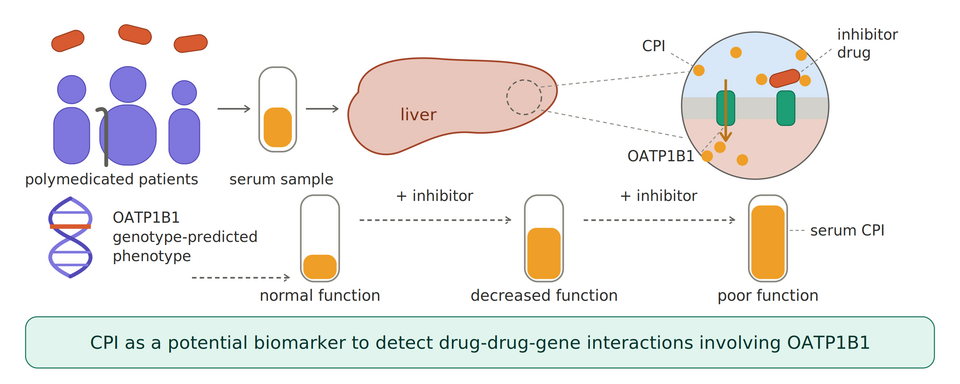
Coproporphyrin I (CPI) is an established endogenous biomarker for detecting drug–drug interactions (DDIs) involving the hepatic uptake transporter Organic Anion Transporting Polypeptide 1B1 (OATP1B1, gene SLCO1B1). While CPI has been extensively studied in healthy volunteers using controlled pre- and post-OATP1B1-inhibitor sampling, its applicability in samples obtained in clinical routine from multimorbid, polymedicated patients remains poorly characterized. In this study, we evaluated whether single timepoint CPI concentrations obtained in clinical routine can be used to assess in vivo OATP1B1 activity by integrating genetic and pharmacological information. Serum CP levels were measured in patients undergoing pharmacist-led medication reviews following therapy failure or adverse drug reactions. CPI concentrations were analyzed in relation to genotype-predicted OATP1B1 phenotypes and exposure to drugs with potential impact on OATP1B1, which were identified following a previously published work by Stäuble et al., and their interaction with OATP1B1 was further evaluated with the herein presented in vitro transporter assay. CPI levels showed an association with drug intake and genotype-predicted phenotypes. Moreover, patients with decreased- or normal function phenotypes taking putative OATP1B1 inhibitors exhibited CPI levels comparable to patients carrying the poor-function or decreased-function phenotype without intake of such drugs, respectively, consistent with phenoconversion. These findings provide initial evidence that CPI may serve as an endogenous biomarker for identifying drug–drug-gene interactions in clinical routine to support a safer and more effective drug therapy. Furthermore, our data emphasize the need for further investigations in larger and more diverse patient populations to validate the findings on CPI. Read more