

/ Forschung
Next‑generation high‑throughput in vitro exposure system for early hazard ranking and comparative assessment of cigarette smoke and heated tobacco aerosols
Bei dem Projekt handelt es sich um eine Kooperation mit Dr. Garcia-Käufer/Uniklinik Freiburg
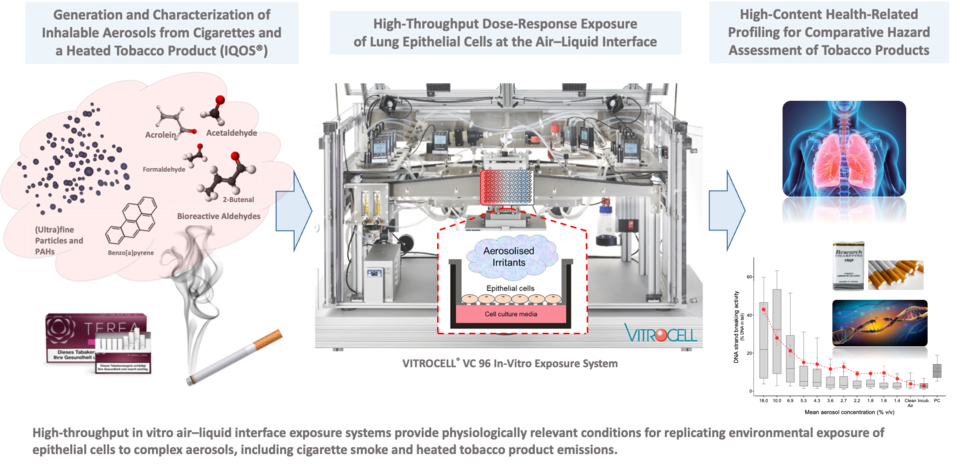
Background Accuracy, along with reproducibility and transferability, are essential attributes of modern in vitro inhalation exposure systems to reliably assess the hazard potential of complex aerosols and remain aligned with advancements in molecular and cellular biology. Although in vitro lung exposure models are continually being refned, no standardized or harmonized methodologies have yet been established or universally accepted. This study addresses the existing gap by evaluating a novel exposure system designed to generate physiologically relevant in vitro inhalation data. The system is based on a high-throughput 96-well platform operating under continuousfow air–liquid interface conditions, enabling controlled, reproducible, and scalable aerosol exposures. To evaluate exposure system performance, reference cigarette smoke (1R6F) was applied and subsequently compared with heated tobacco aerosol (IQOS) using an alveolar epithelial cell model (A549). The study aimed to demonstrate the reliability of the high-throughput exposure technology and its applicability for emission prioritization using a tiered in vitro test battery.
Results The high-throughput exposure system (HTES) delivers aerosols to cell based test systems cultured at the air–liquid interface (ALI) in 96-well insert microplates, facilitating the acquisition of consistent and interpretable dose–response relationships. It provides 11 aerosol concentration levels in a single batch, including a vehicle control and eight technical replicates per level, yielding 96 data points. The consistency between nominal dose metrics and induced biological responses, evaluated through a predictive assay panel (cytotoxicity, genotoxicity, immunomodulation), confrms both accuracy and reproducibility. A comparative evaluation of 1R6F and IQOS emissions, supported by chemical analyses, demonstrated the method’s applicability across aerosol types and enabled the determination of relative potency equivalents, which facilitate the ranking of tobacco products. 1R6F smoke exhibited a substantially higher acute potency than IQOS aerosol, although both caused genotoxic efects. Additionally, the successful implementation of high-content assays, such as in situ γ-H2AX analysis, highlights the system’s potential for applications beyond traditional hazard screening. Read more