

/ Forschung
The 4-alkyl chain length of 2,5-dimethoxyamphetamines differentially affects in vitro serotonin receptor actions versus in vivo psychedelic-like effects
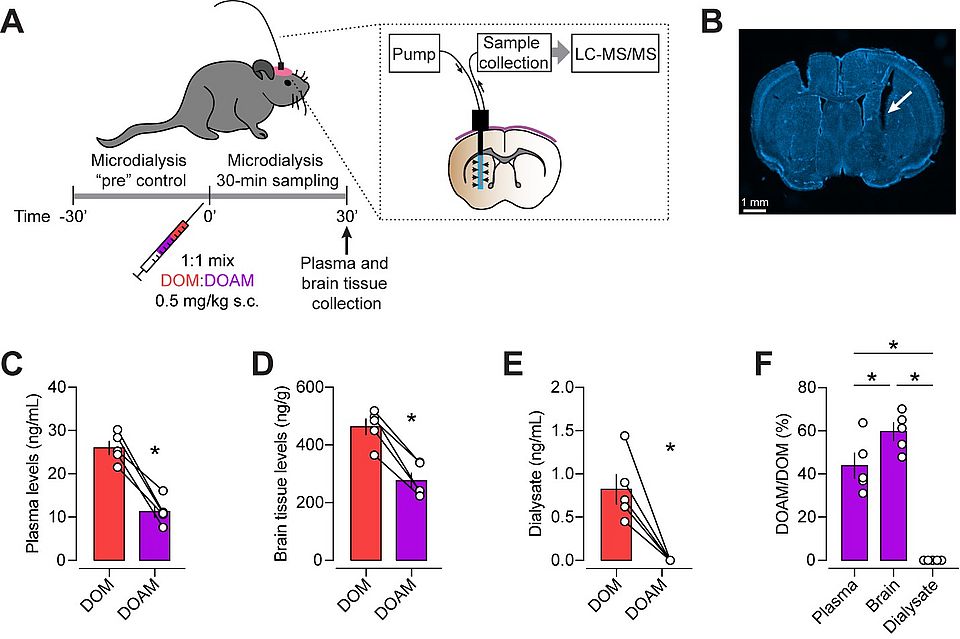
Various ring-substituted α-methylphenethylamines (i.e., amphetamines) produce psychedelic-like effects that are primarily mediated by activity at 5-hydroxytryptamine 2A (5-HT2A) receptors. Small lipophilic substituents at the 4-position of the 2,5-dimethoxyamphetamine core structure can greatly enhance the clinical potency of such derivatives. Here, we studied the effects of various 4-alkylated 2,5-dimethoxyamphetamines (4-methyl, 4-ethyl, 4-propyl, 4-butyl, 4-amyl) on in vitro receptor activities and in vivo psychedelic-like effects in mice. The acute effects of the compounds were examined using the mouse head-twitch response (HTR) assay, a proxy for psychedelic-like drug actions. Overall, the series primarily interacted with 5-HT2 receptor subtypes, with increasing 4-alkyl chain length associated with increased affinity at 5-HT2A receptors. For all three in vitro functional readouts assessed, the 4-propyl analog produced the highest potencies for 5-HT2A receptor activation (1–9 nM), but smaller and longer chain lengths displayed comparable activities (2–56 nM). In mice, the compounds displayed variable maximal HTR counts (23–119) and potencies (0.42–2.76 mg/kg), with the 4-propyl and 4-methyl compounds being the most potent and efficacious, respectively. Analysis of drug concentrations in mouse plasma, brain tissue, and brain dialysate samples revealed that derivatives with longer alkyl chains (i.e., butyl, amyl) require higher systemic doses to achieve concentrations comparable to those of short-chain analogs. These findings demonstrate that extending the 4-position alkyl chain beyond a propyl group reduces in vivo potency and efficacy, in part due to pharmacokinetic parameters. Read more