
/ Forschung
New Analogs of the Compstatin Family of Clinical Complement Inhibitors with Low Picomolar Target Affinity
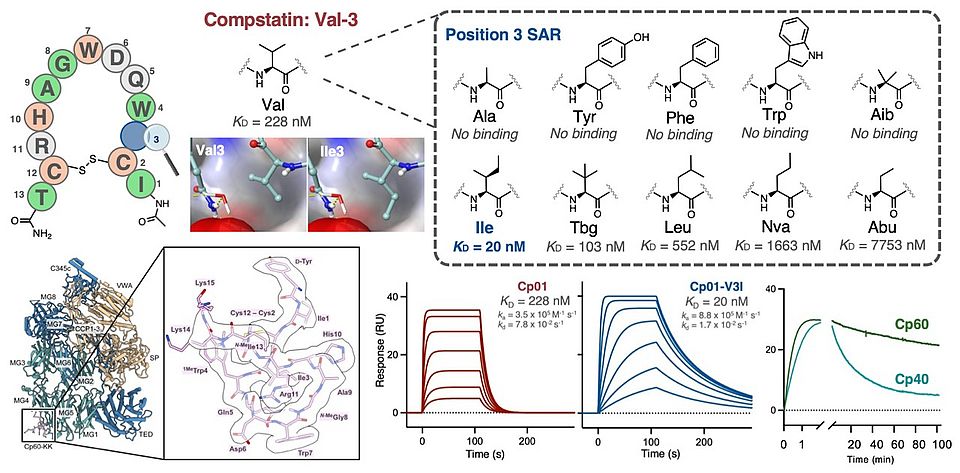
Compstatin-class macrocyclic peptides have emerged as therapeutic complement modulators, with a PEGylated compstatin derivative being approved and sequence-optimized analogs with enhanced PK/PD properties showing clinical promise. By extending structure–activity relationship studies of compstatin, we identified a modification (V3I) that enhances the target affinity up to 30-fold. Analog Cp01-V3I represents the most potent proteinogenic compstatin (KD = 20 nM), opening paths toward recombinant applications. Introducing the V3I modification into late-generation compstatin analogs yielded a low-picomolar-affinity derivative (KD = 0.08 nM), termed Cp60, featuring potent complement inhibition in vitro. Cryogenic electron microscopy of the C3bB-Cp60 complex at 2.88 Å resolution confirmed the structural basis for enhanced target affinity and provided mechanistic insights. Lastly, we demonstrate that Cp60s ultralong target residence time enables diagnostic applications for detecting complement opsonins on biosurfaces. Collectively, this work highlights the importance of rigorous optimization of de novo peptide inhibitors to improve PK/PD properties and enable novel applications. Read more